The King in Yellow
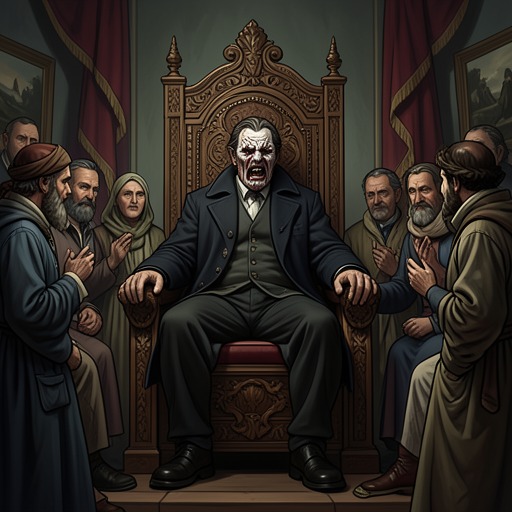
The King in YellowThe King in Yellow is the central figure and governing presence of a forbidden play whose influence extends far beyond the printed page. He is presented as the Last King, a ruler served even by emperors, and as a power connected with Carcosa, Hastur, the Hyades, the Lake of Hali, and the Pallid Mask. Whether he exists as an actual supernatural sovereign, a figure generated by the play, or the organizing delusion of its readers is never securely resolved; what is certain is that the idea of him becomes an active force in the lives of those who encounter it.
Identity and Mythic Setting
The King in Yellow belongs to a dense mythology of lost places, royal succession, and cosmic signs. The opening of the associated song invokes the Hyades and the King, whose “tatters” are linked with the doomed city of Carcosa; the song is identified as Cassilda's Song in The King in Yellow, Act i, Scene 2. The same imaginative geography includes Hastur, Aldebaran, and the Lake of Hali, while the Pallid Mask becomes the figure's most recognizable emblem. These names do not form a simple explanatory system. They appear as fragments of a larger history, repeated across manuscripts, readings, conversations, and visionary states, so that the mythology acquires authority through recurrence rather than through verifiable exposition.
The King is also defined through political language. Mr. Wilde declares that the ambition associated with him surpasses that of Caesar and Napoleon because it seeks not merely territory but control over the minds of men and even their unborn thoughts. When the narrator identifies the subject as the King in Yellow, Mr. Wilde answers that this is a king whom emperors have served. The formulation turns a legendary monarch into an image of absolute ideological power: his dominion is imagined as the conquest of consciousness itself.
The Forbidden Book and Its Effect
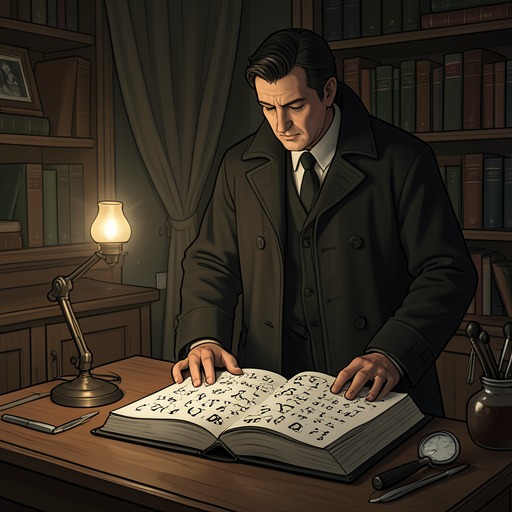
The King in Yellow first reaches the reader as a book and a play rather than as a visible person. During convalescence, the narrator reads it, attempts to throw it into the fireplace after the first act, then retrieves it after glimpsing the opening words of the second. He reads the second act in terror and fascination, afterward describing Carcosa, black stars, the sinking twin suns, the Lake of Hali, and the memory of the Pallid Mask as permanent burdens on his mind. The encounter produces laughter, tears, trembling, and a horror that continues to assail him, making the book's effect inseparable from the reader's altered consciousness.
The play's public history intensifies its danger. The French Government seizes translated copies arriving in Paris and London, while the work spreads from city to city and continent to continent. It is barred, confiscated, denounced by the Press and pulpit, and censured even by literary anarchists. Yet no definite principle, doctrine, or recognizable conviction is violated by its pages, and it cannot be judged by any established standard. Its threat lies instead in the contrast between the apparent banality and innocence of the first act and the devastating force of what follows. The book's artistic perfection is therefore presented as part of its poison: its language can fascinate and paralyze precisely because it appears lucid, musical, and universally intelligible.
The same danger appears in Alec's studio, where he accidentally reads The King in Yellow while Boris Yvain and Jack Scott experiment with a petrifying liquid. Alec puts the volume away with a nervous shudder, but the reading has already entered a scene of scientific and emotional crisis. Later, another reader refuses even to open the book, citing the tragedy of young Castaigne and the belief that its “truths” send men frantic and blast their lives. The varying responses—compulsion, avoidance, condemnation, and reverence—show that the King governs readers before they agree about what he is.
Political and Personal Possession
Mr. Wilde uses the King's mythology as the ideological foundation for the Imperial Dynasty of America. A manuscript bearing that title traces an alleged succession from Carcosa and includes the dynastic names and claims that the narrator studies obsessively. It identifies Louis Castaigne and establishes Hildred Castaigne as first in succession. The manuscript gives the King's imagined sovereignty a bureaucratic form: genealogy, heraldry, ledgers, lists of names, and plans for mass communication turn occult legend into a program of political seizure.
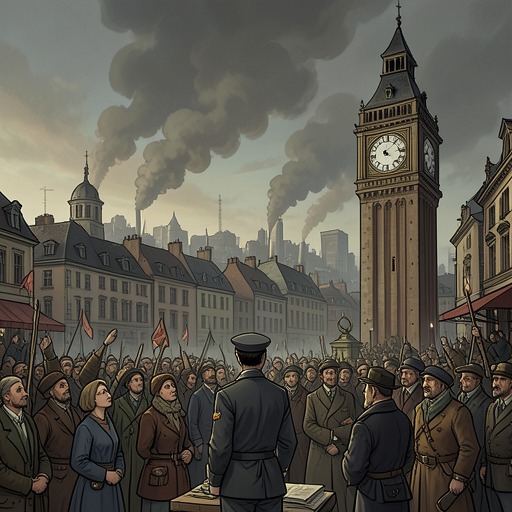
Mr. Wilde claims that the movement is already in communication with ten thousand men, expects one hundred thousand within twenty-eight hours, and predicts that the state will rise en masse within forty-eight hours. He says that the regions unwilling to follow, including California and the Northwest, might better never have been inhabited, and adds that he will not send them the Yellow Sign. The sign thus functions as both summons and test: those who receive it are expected to obey, while refusal places entire populations outside the imagined new order.
The political fantasy becomes a personal claim to kingship. Mr. Wilde explains the supposed imperial family to Osgood Oswald Vance, drawing on volumes of heraldry and moving through Carcosa, Hastur, Aldebaran, the Hyades, Demhe, the Lake of Hali, Cassilda, Camilla, Uoht, Thale, Naotalba, the Phantom of Truth, and Aldones before recounting the story of the Last King. The narrator then tells Vance that he alone is worthy of the crown and that his cousin Louis must be exiled or die. Louis must not marry, even after renouncing his claims, and especially must not marry Constance Hawberk, whose connection could bring England into the succession dispute. The Yellow Sign becomes the instrument by which this imaginary dynasty is meant to compel the city, the state, and the country to rise before the Pallid Mask.
Crown, Violence, and Collapse
The narrator's assumption of the King's identity reaches its most literal form after Vance enters the Government Lethal Chamber and the narrator concludes that Hawberk and Constance are no longer obstacles. He tells Louis that he has ceased to be a menace, declares that Mr. Wilde will take charge of him, and flees into the building associated with Hawberk. In Mr. Wilde's rooms he finds the door open, takes a diadem from its case, puts on a white silk robe embroidered with the Yellow Sign, and places the crown on his head. He believes himself king by right through Hastur, because he knows the mystery of the Hyades and has sounded the depths of the Lake of Hali. He expects dawn to unleash a tempest capable of shaking two hemispheres.
The coronation is immediately destroyed by violence. Hearing a groan in the passage, the narrator attacks in the darkness; his knife strikes the cat, and when he raises a lamp he finds Mr. Wilde on the floor with his throat torn open. For a moment the dying man's eyes and trembling hand give the narrator hope that he may survive, but Mr. Wilde dies. The narrator sees his crown, empire, ambitions, and life collapsing with the dead master. Police then seize and bind him, while he rages, bites at them, and remains convinced of his royal destiny. Louis appears with a ghastly face, and Constance stands weeping behind Hawberk. The scene makes the King's supposed ascension indistinguishable from psychological breakdown, homicide, and confinement.
The Yellow Sign and the King as Recurring Presence
The King's influence recurs even among people who have deliberately avoided the book. In Jack Scott's rooms, a volume bound in serpent skin is unexpectedly discovered on a high shelf. The resident has never bought or opened it, and has avoided descriptions of its second part because of the tragedy of young Castaigne. Tessie Reardon nevertheless takes the book, opens the second part, and is found dazed beside it. The resident then reads the entire volume from beginning to end, despite his fear and earlier refusal.
Afterward, the two readers speak in a dull, monotonous strain and gradually realize that they are discussing The King in Yellow. They praise and condemn its crystalline, musical language while recognizing its ability to fascinate and paralyze. Tessie urges the resident to discard a black onyx clasp inlaid with the Yellow Sign, but he cannot bring himself to remove it. Through the night they speak of the King, the Pallid Mask, Hastur, Cassilda, the Hyades, and the Phantom of Truth, while fog presses against the windows like waves on the shores of Hali. Their shared understanding appears to dissolve the boundary between separate minds, and the arrival of a black-plumed hearse signals that a creature is coming for the Yellow Sign. The King therefore remains present even without a visible body: he survives as text, emblem, contagion, political myth, and approaching doom.